
Last Updated: November 7, 2026
Quick Summary
Ethical meat comes from animals raised with humane treatment, good living conditions and responsible land use. To identify it, check where the animal lived, what it ate and how it was handled, since labels alone rarely tell the full story. Verify claims through certifier directories and farm records.
- USDA Organic covers feed, antibiotics and hormones but does not require pasture access.
- Certified Humane and Animal Welfare Approved set specific welfare standards you can compare.
- Confirm a certification by searching the producer in the certifier's public directory.
- Ask the seller for the farm location and the name of each operation handling the animal.
- Request the slaughter facility name and whether it is inspected by USDA or state authorities.
Table of Contents
- What Ethical Meat Actually Means
- Reading Meat Labels and Certifications
- A Species-by-Species Welfare Checklist
- How to Verify Claims Beyond the Package Label
- Questions to Ask Farmers and Suppliers
- How to Find a Local Farmer to Buy Meat From
- Evaluating Ethically Sourced Meat Brands Like Makana Wild
- Choosing Your First Ethical Purchase
- Frequently Asked Questions
What Ethical Meat Actually Means
Ethical meat is meat from animals raised with humane treatment, good living conditions and responsible land use. Buying it means knowing what to look for, because labels alone rarely tell the full story. The best way to judge a product is to check where the animal lived, what it ate and how it was handled.
The term "ethical" covers several concerns at once. Animal welfare, environmental impact and food safety all matter, and they do not always point the same way. A product can score well on one and poorly on another. That is why this guide walks through a checklist instead of a single rule.
Many shoppers assume "natural" or "humane" means the same thing everywhere. It does not. USDA Food Safety and Inspection Service labeling guidance sets rules for some label claims, but many words on the package are never defined by law. Read claims with that gap in mind.
Reading Meat Labels and Certifications
Labels are the fastest way to start, and also the easiest to misread. Our hormone-free beef guide explains what claims like hormone-free mean for health and ethics. Some terms are regulated. Others are marketing language with no fixed meaning. Learning the difference saves money and avoids confusion.
Start with the claims that carry legal weight. USDA Agricultural Marketing Service certification programs administers several voluntary standards that third parties audit. Those are more reliable than a phrase printed on the front of a bag.
What Organic Certification Does and Does Not Guarantee
USDA Organic certification covers how animals are fed and whether they receive antibiotics or growth hormones. It does not guarantee outdoor access, grazing or a low-stress life. An organic animal can still live indoors in a crowded barn.
- Organic covers feed, antibiotics and hormones
- Organic does not require pasture access
- Organic says little about transport or slaughter
Comparing Certification Standards
Third-party welfare certifications go further than organic. Our grass-fed vs grain-fed comparison explains what actually matters when comparing these standards. Look for programs that audit living conditions, handling and slaughter, and check whether the audit is independent of the seller.
- Certified Humane and Animal Welfare Approved set specific welfare standards
- Global Animal Partnership uses a tiered rating system
- Read what each standard requires, not just its name
A Species-by-Species Welfare Checklist
Different animals have different needs, so a single checklist misses important details. Use this list as a starting point for each product you consider.
- Beef cattle: Look for access to pasture, grass-based diets and minimal time in feedlots.
- Venison and wild game: Ask whether animals were wild-harvested, how they were killed and how quickly the meat was chilled.
- Pork: Check for outdoor access or enriched housing, and confirm the absence of gestation crates.
- Poultry: Look for outdoor range access, lower stocking density and slower-growing breeds.
Watch out: Wild-harvested game can carry different food safety risks than farm-raised meat, so ask how the product was processed and stored.
The checklist below summarises what to look for in each type of animal, so you can scan the welfare points quickly.
| Animal | What to look for | Watch out for |
|---|---|---|
| Beef cattle | Pasture access, grass-based diet | Time spent in feedlots |
| Venison and wild game | Wild-harvested, how animals were killed, how fast meat was chilled | Different food safety risks than farm-raised meat |
| Pork | Outdoor access or enriched housing | Gestation crates |
| Poultry | Outdoor range access, lower stocking density | Fast-growing breeds |
How to Verify Claims Beyond the Package Label
A label is a claim, not proof. Verifying it takes a few extra steps, and the steps differ depending on whether the package carries a certification, a producer name, or only a marketing phrase. The goal is to trace the product from the package back to a specific farm or certifier record.
If the package carries a certification, start with the certifier's public directory. Most third-party programs publish a searchable list of certified producers. Search the farm name exactly as it appears on the package. If the producer is not listed, or the listing has lapsed, the claim is unverified regardless of what the logo says. Note the certification date and the products covered, because a farm can be certified for one species and not another.
If the package names a farm or ranch, ask the seller for the farm's location and whether the animals were raised there from birth to harvest. A common pattern is a package that names a farm which supplied only the finishing stage, while the animal was raised elsewhere. Ask for the name of the operation that handled each stage: birth and raising, finishing, transport, and slaughter.
If the package uses only marketing language, "natural," "humane," "sustainable," "family-owned", treat the phrase as a starting question rather than an answer. Ask the seller to define the term in writing and to name the standard or auditor behind it. A supplier who cannot define its own claim is telling you something useful.
Concrete records to request:
- The certifier name and the producer's directory listing.
- The farm name and location for each stage of the animal's life.
- The name and location of the slaughter facility, and whether it is inspected by USDA or state authorities.
- A lot number or harvest date that links the package to a specific production run.
- Any third-party audit reports the seller is willing to share, even in summary form.
Watch out: A farm visit or video tour is useful, but it shows conditions on the day of the visit, not the full production cycle. Pair a visit with records that cover the whole raising period.
Red flags that warrant caution:
- The seller cannot name the certifier behind a certification logo.
- The producer does not appear in the certifier's directory.
- The farm name changes between the website and the package.
- The seller answers questions about raising conditions but deflects questions about transport or slaughter.
- The only documentation offered is a marketing brochure rather than an audit summary or directory listing.
Verification does not require a research project. Two or three checks, the certifier directory, the farm name, and the slaughter facility, will separate a traceable product from a claim that rests on packaging alone.
Questions to Ask Farmers and Suppliers
A direct conversation reveals more than any label. Good suppliers welcome these questions and answer them plainly.
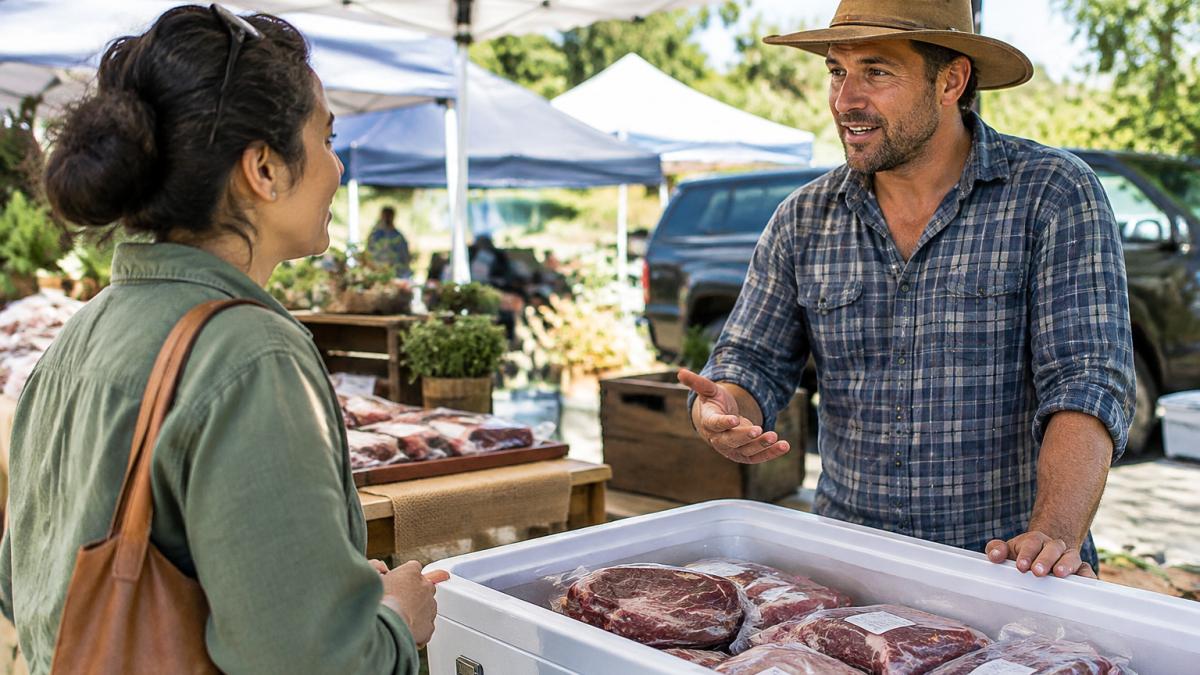
- What did the animals eat, and where did they spend their time?
- How are animals handled during transport and slaughter?
- Do you use antibiotics or growth promoters, and under what conditions?
- Can I visit the farm, or see photos and records of it?
- Which third-party audits do you undergo, and when was the last one?
Vague answers, or no answers at all, tell you what you need to know.
How to Find a Local Farmer to Buy Meat From
Local sourcing often gives you the most direct view of how animals are raised. Start with farmers markets, cooperative extension offices and online farm directories. Many producers sell direct and will show their operation if you ask.
Visit when you can. A farm visit shows the land, the animals and the handling practices in person. If a visit is not possible, ask for a video tour or a written description of daily care.
Evaluating Ethically Sourced Meat Brands Like Makana Wild
Brands vary widely. Our assessment of island-raised grass-fed beef shows whether this kind of sourcing is worth its price. Some publish detailed sourcing information, and others say little beyond a logo. Makana Wild sells wild-harvested venison, and its products are described as ethically sourced and free from antibiotics, hormones and pesticides. Judge any brand by the same test: can it show you where the meat came from and how it was raised?
Shoppers comparing brands often look at traceability, certification, and whether the company explains its harvesting or ranching practices. You can read more about our sourcing approach and how to verify wild venison sourcing before you decide.
Choosing Your First Ethical Purchase
Start small. Pick one product, check its label and certification, ask the seller one or two questions, and see how the answers compare with what you expected. Over time, you will build a short list of sources you trust.
If you want a product with a short ingredient list to try, the Makana Wild Carnivore Chips Hawaii Wild Harvested Venison 1 oz at $9.99 are a simple place to begin. They contain only venison and Hawaiian Alaea sea salt, so the ingredient list is easy to check.

Frequently Asked Questions
Is grass-fed meat always more ethical?
Not necessarily. Grass-fed describes diet, not welfare. A grass-fed animal can still be confined, transported long distances or slaughtered without adequate stunning. Check whether the label is backed by third-party animal welfare certification, such as Animal Welfare Approved or Certified Humane, and ask how animals access pasture and how they are handled at slaughter.
How can I tell if meat was raised humanely?
Look for third-party certification rather than marketing terms like natural or farm fresh, which the USDA does not define in terms of animal welfare. Certifications such as Global Animal Partnership and Animal Welfare Approved audit farm conditions. Where possible, ask the producer for documentation of outdoor access, stocking density and slaughter practices.
What questions should I ask a farmer before buying meat?
Ask where the animals were born and raised, what they ate, whether they had outdoor access, how they were transported and where they were processed. Ask whether antibiotics or hormones were used and how that is documented. Vague or evasive answers are a red flag. A reputable producer will answer these questions directly.
Does organic certification guarantee ethical treatment?
No. USDA Organic certification governs feed, antibiotic and pesticide use, and outdoor access rules, but it does not set standards for slaughter or many aspects of day-to-day animal welfare. Organic is a useful signal, but it should be combined with a welfare certification for a fuller picture.